

Dubai and the UAE have embraced AI as a core pillar of economic growth. The UAE was an early adopter of AI – even appointing a Minister of Artificial Intelligence and integrating AI into national strategy (UAE AI Strategy 2031). In Dubai, the leadership approved a package of AI initiatives (such as an AI Infrastructure Empowerment Platform and an AI Acceleration Taskforce) to “fast-track Dubai’s digital transformation” and make the emirate “the world’s fastest, smartest and most prepared city to adopt future technologies”. Today UAE is ranked among the top five cities globally for AI adoption and a top-four FinTech hub. These initiatives from government councils to financial-sector sandboxes have created a strong ecosystem for AI in UAE’s businesses and financial sector.
AI Adoption in Dubai’s Business and Financial Sectors
Adoption of AI in Dubai’s businesses is accelerating rapidly. Recent survey data from the DFSA show that over half (52%) of firms in Dubai’s main financial zone (DIFC) are actively using AI – up from 33% just one year earlier. Generative AI use, in particular, jumped by 166% in a year. A 2025 KPMG report found that 49% of UAE companies already have active AI projects in finance, compared to just 35% globally. Most organizations plan to increase AI use: roughly 60% of Dubai financial firms expect to expand AI in the next 12 months and 75% over three years. This growth is underpinned by UAE strategies: Dubai (and the UAE) have built AI campus zones, incubators, and regulatory frameworks that encourage innovation.
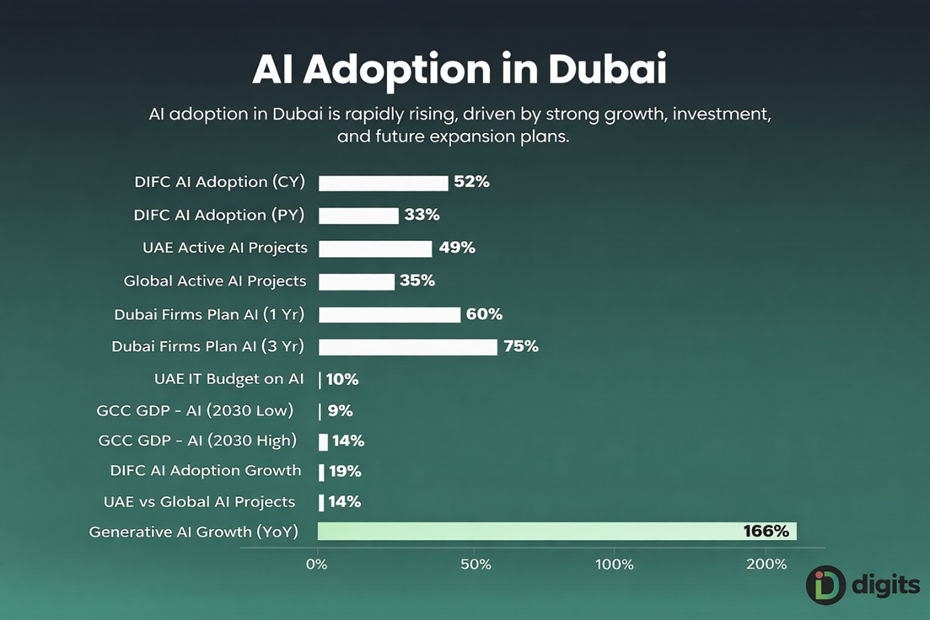
Key stats: Dubai is among the top world-leading AI Adoptive cities – the DIFC survey shows AI use in finance rising to 52% of firms in 2025. UAE organizations spend about 10% of IT budgets on AI (nearly matching global leaders). In fintech, GCC countries are on track to capture as much as 9-14% of GDP from AI by 2030. In short, businesses in Dubai are moving quickly to leverage AI-driven analytics, automation, and new AI-enabled services.
Benefits of AI for Business and Finance
AI offers substantial benefits for businesses and financial services in Dubai. It can automate routine tasks, improve decision-making, and deliver faster insights. As IBM notes, AI “uses internal and external data to optimize processes, eliminate repetitive tasks and enable smarter decisions”. By processing massive data volumes, AI gives managers real-time analytics and predictive insights that humans cannot easily produce. For example, AI-powered tools can automate report generation, risk analysis, and customer service (e.g. chatbots) so that employees focus on strategy.
Real-world evidence supports these gains. In banking, AI-driven fraud detection can cut false positives by 90%, and AI-based credit models yield real-time lending decisions. Global studies show AI reduces costs and speeds growth: customer acquisition costs have fallen by 75% and compliance workloads by two-thirds in some financial firms using AI. In practice, banks like Emirates NBD (UAE) used AI and advanced analytics to automate reporting and risk assessment, transforming 20M+ customer data into personalized services. Overall, AI can boost efficiency (reducing human error in data entry, invoicing, bookkeeping, etc.) and improve accuracy in forecasting and fraud detection. Organizations also see cost savings from automation – IBM observes that AI “typically reduces operational costs through automation, optimization and prevention of costly errors”.
Summary of benefits: AI speeds up workflows and insights, enabling smarter decisions and cost savings. Businesses using AI can scale operations (24/7 automation), personalize customer experiences with AI chatbots or recommendations, and innovate new products. In short, Dubai firms that effectively deploy AI tend to gain competitive advantage through higher productivity and lower costs.
Challenges and Risks of AI in Business and Finance

Despite its promise, AI adoption comes with notable challenges and risks. Many Dubai organizations have found that early AI investments take time to yield value. For example, only 37% of UAE finance leaders reported a positive AI return on investment, versus 66% globally – underscoring that turning AI pilots into real impact is hard. Large-scale AI projects often require significant upfront investment and time before results materialize. Our review found common obstacles in Dubai: legacy IT systems, scattered data and limited expertise. As one UAE bank (Emirates NBD) put it, they faced “huge volumes of uncatalogued, multisourced data of varying quality” which made analytics difficult. Many finance teams still lack the skills and integration needed to scale AI beyond initial trials.
Other challenges include technical and ethical risks. AI models can be brittle or biased if not carefully managed. Dubai businesses must ensure data privacy and avoid discriminatory outcomes. Cybersecurity is also a concern: AI tools open new attack surfaces if not secured properly. Moreover, widespread automation raises workforce and social questions. Financial institutions in the UAE are aware of these issues and preparing. For instance, firms note gaps in AI governance – one survey found 21% of financial firms using AI have no clear oversight for it.
Finally, operational risks arise when AI systems make critical decisions without human checks. Generative AI can sometimes hallucinate or produce errors, which is problematic in finance. Integration costs, vendor lock-in and ongoing maintenance are further downsides. In summary, while AI can drive growth, organizations must address data quality, governance, and training to actually capture the benefits without unintended consequences.
Regulation and Ethics in the UAE Financial Sector
Dubai’s strong regulatory framework helps mitigate AI risks. The UAE Central Bank has issued guidance specifically on “responsible use of AI” in finance. Key principles include governance, accountability, transparency, and fairness. The guidance requires financial firms to establish documented AI governance frameworks and integrate AI risk into their overall risk management. In practice, banks must keep inventories of AI models, “stress-test” them for bias, and maintain human oversight even for automated systems.
Crucially, regulators emphasize consumer protection. UAE rules forbid using AI to mislead or discriminate against customers. AI-driven decisions must align with a bank’s duty of care: systems must not result in discriminatory, manipulative or unfair outcomes. Institutions are obliged to disclose AI usage clearly: customers should know if a decision (loan approval, investment advice, etc.) was AI-assisted, and be given opt-out or appeal mechanisms. All explanations and disclosures must be provided in both Arabic and English to ensure transparency.
The Central Bank’s Guidance Note also aligns with the UAE’s broader AI strategy. It spells out core AI ethics: fairness, non-discrimination, explainability, privacy and robust human oversight. In short, Dubai’s regulators recognize AI’s power and set expectations accordingly: firms must prioritize security, data protection, and governance as they deploy AI systems. Financial companies in Dubai are also watching global trends and preparing compliance (e.g., data protection laws) to ensure any AI use meets high standards of ethics and stability.
How Digits Can Drive AI-Enabled Transformation
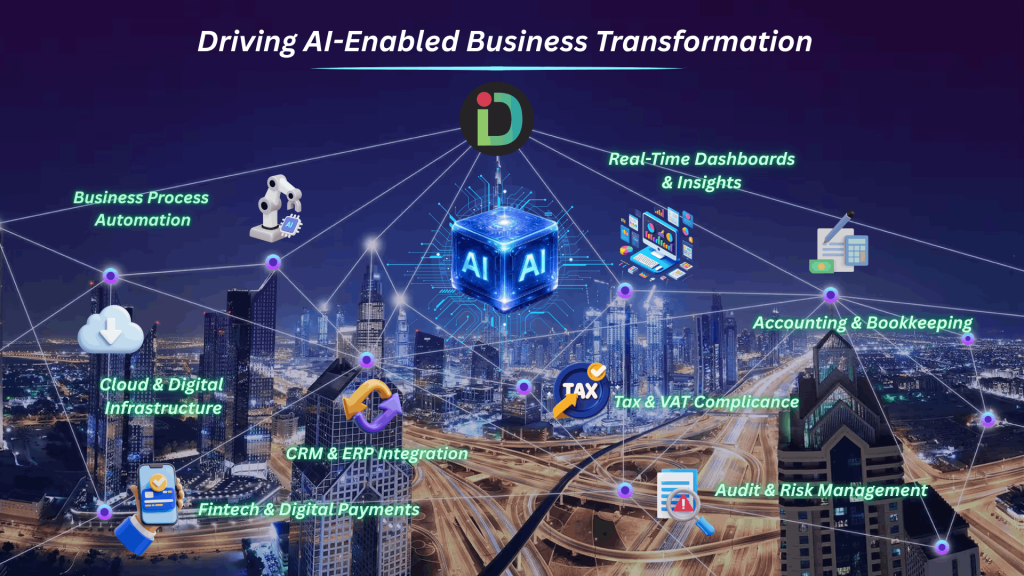
Innovative companies in Dubai need the right technology and expertise to harness AI. Digits offers end-to-end solutions that bridge finance and technology. For example, our Business Process & Digital Transformation services streamline operations by integrating systems (accounting, CRM, payroll, inventory) and automating workflows. This reduces manual tasks by 30–50% and gives management a unified real-time view of cash flow and margins. On the technology side, Digits guides firms through Cloud, AI & Automation – migrating data to secure cloud platforms and building AI-driven dashboards for business insights. We help deploy low-code/RPA automation and predictive analytics so that decision-makers see actionable insights faster.
For finance teams, Digits provides Financial Reporting & Advisory expertise to embed AI insights into budgeting, forecasting and compliance. Our accounting and ERP services help clients move beyond spreadsheets into ERP environments with live analytics, freeing up time for strategic planning. We also advise banks and fintechs on new digital products – for instance, our Fintech, Payments & Wallet Advisory can support AI-driven loyalty programs or digital wallet platforms. In each case, Digits ensures AI initiatives align with UAE regulations and industry best practices, so you gain innovation and trust.
Take the next step: Whether you’re a SME or a large enterprise, Digits can help you navigate AI adoption responsibly. Our team combines local UAE finance expertise with modern tech skills. Contact Digits today to learn how our Business Process & Digital Transformation and Cloud, AI & Automation solutions can modernize your operations. Let’s work together to unlock the full potential of AI in your business – enhancing efficiency, insight and growth while staying fully compliant with regulatory and ethical standards.
Sources: UAE AI Strategy 2031, AI Infrastructure Empowerment Platform and an AI Acceleration Taskforce, DFSA, IBM, Emirates NBD (UAE), Responsible Use of Artificial Intelligence in the Financial Sector
Read Our Other Blogs:




Corporate Tax Planning in the UAE: How Businesses Can Improve Tax Efficiency While Staying Compliant