
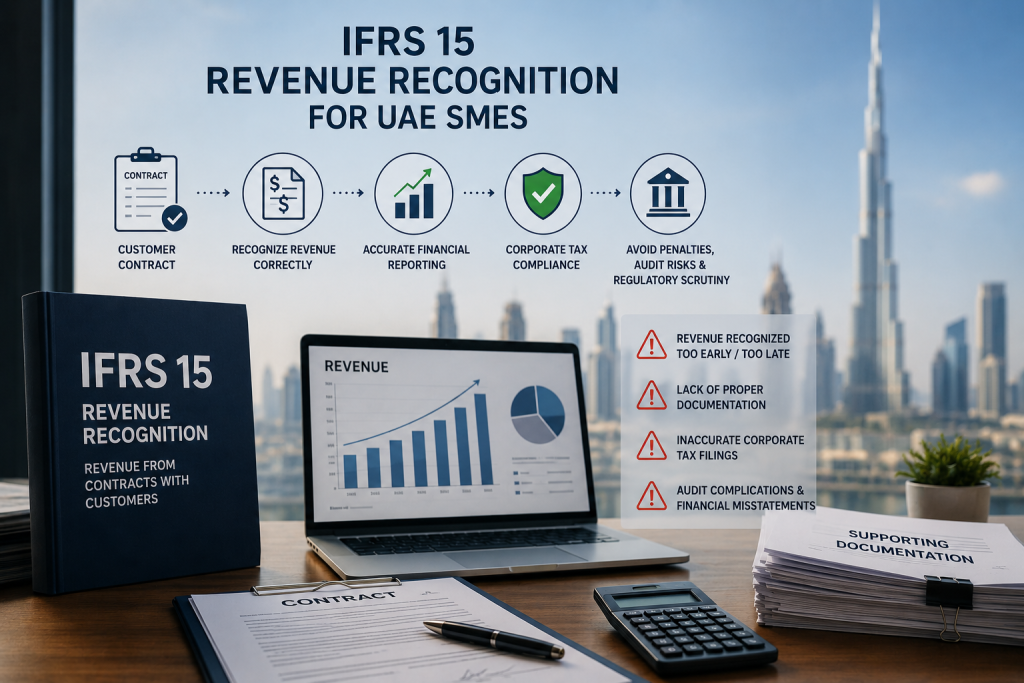
As the UAE business environment becomes increasingly regulated under Corporate Tax and financial reporting frameworks, IFRS 15 revenue recognition has emerged as one of the most important accounting compliance areas for SMEs.
Many businesses in the UAE still recognize revenue incorrectly, either too early, too late, or without proper supporting documentation. In 2026, this can lead to serious consequences including inaccurate Corporate Tax filings, audit complications, financial misstatements, and regulatory scrutiny.
This is where IFRS 15 becomes critical.
IFRS 15, Revenue from Contracts with Customers, establishes a standardized framework for how businesses should recognize revenue. For SMEs operating in the UAE, understanding and implementing IFRS 15 is now essential for maintaining accurate financial reporting and ensuring compliance with Corporate Tax regulations.
What is IFRS 15?
IFRS 15 is the international accounting standard that governs how businesses recognize revenue from customer contracts.
Introduced by the International Accounting Standards Board (IASB), IFRS 15 replaced multiple older revenue recognition standards and created a single unified framework applicable across industries.
The objective of IFRS 15 is simple:
Businesses should recognize revenue when control of goods or services is transferred to customers, and in an amount that reflects the consideration the business expects to receive.
In the UAE, IFRS 15 directly impacts:
- Financial statement accuracy
- Corporate Tax calculations
- Audit readiness
- VAT reporting alignment
- Profitability analysis
- Investor confidence
Why IFRS 15 Matters for UAE SMEs in 2026
With Corporate Tax implementation now fully active across the UAE, financial reporting standards are under greater scrutiny than ever before.
Revenue is one of the most significant figures in any company’s financial statements. Incorrect revenue recognition affects:
- Taxable income
- Profit margins
- Cash flow reporting
- Audit outcomes
- Financial credibility
For SMEs, improper application of IFRS 15 can result in:
- Overstated or understated revenue
- Incorrect Corporate Tax filings
- Financial reporting inconsistencies
- Regulatory penalties
- Disputes during audits
As UAE authorities continue strengthening compliance expectations, businesses must ensure that revenue recognition policies align with IFRS 15 requirements.
The 5-Step IFRS 15 Revenue Recognition Model
IFRS 15 follows a structured five-step model for recognizing revenue.
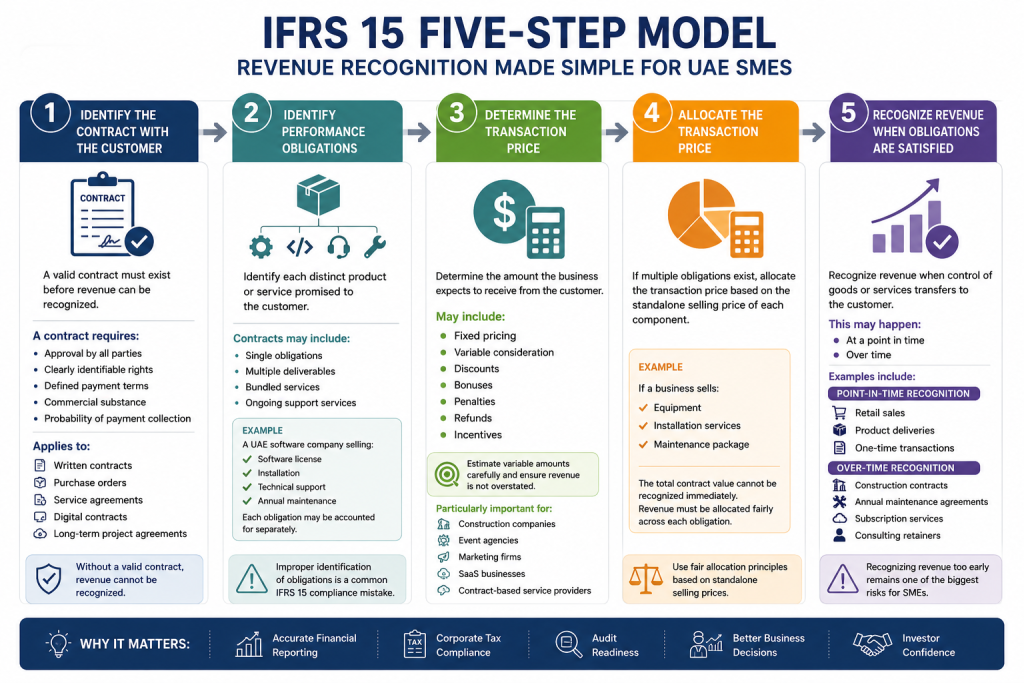
Understanding this framework is essential for UAE SMEs.
Step 1: Identify the Contract with the Customer
A business must first determine whether a valid contract exists.
A contract under IFRS 15 generally requires:
- Approval by all parties
- Clearly identifiable rights
- Defined payment terms
- Commercial substance
- Probability of payment collection
This applies to:
- Written contracts
- Purchase orders
- Service agreements
- Digital contracts
- Long-term project agreements
Without a valid contract, revenue cannot be recognized under IFRS 15.
Step 2: Identify Performance Obligations
A performance obligation refers to a distinct product or service promised to the customer.
Businesses must identify whether contracts contain:
- Single obligations
- Multiple deliverables
- Bundled services
- Ongoing support services
For example:
A UAE software company selling:
- Software license
- Installation
- Technical support
- Annual maintenance
may need to account for each obligation separately.
Improper identification of obligations is one of the most common IFRS 15 compliance mistakes.
Step 3: Determine the Transaction Price
The transaction price is the amount a business expects to receive from the customer.
This may include:
- Fixed pricing
- Variable consideration
- Discounts
- Bonuses
- Penalties
- Refunds
- Incentives
Businesses must estimate variable amounts carefully and ensure revenue is not overstated.
This is particularly important for:
- Construction companies
- Event agencies
- Marketing firms
- SaaS businesses
- Contract-based service providers
Step 4: Allocate the Transaction Price
If multiple performance obligations exist, the transaction price must be allocated appropriately.
Allocation is generally based on the standalone selling price of each component.
For example:
If a business sells:
- Equipment
- Installation services
- Maintenance package
The total contract value cannot simply be recognized immediately.
Instead, revenue must be distributed across each obligation based on fair allocation principles.
Step 5: Recognize Revenue When Obligations Are Satisfied
Revenue is recognized when control of goods or services transfers to the customer.
This may happen:
- At a point in time
- Over time
Examples include:
Point-in-Time Recognition
- Retail sales
- Product deliveries
- One-time transactions
Over-Time Recognition
- Construction contracts
- Annual maintenance agreements
- Subscription services
- Consulting retainers
Recognizing revenue too early remains one of the biggest risks for SMEs.
Industries in UAE Most Affected by IFRS 15
While IFRS 15 applies across industries, some sectors face higher complexity.
Construction and Contracting
Revenue often spans multiple accounting periods.
Businesses must determine:
- Percentage of completion
- Contract modifications
- Milestone billing treatment
- Project-based revenue allocation
Real Estate
Developers must assess when control transfers and whether revenue should be recognized progressively or upon completion.
SaaS and Technology Companies
Subscription-based revenue models require careful allocation across service periods.
Marketing and Creative Agencies
Projects involving retainers, campaign phases, or performance-based payments often create IFRS 15 challenges.
E-Commerce Businesses
Returns, discounts, promotional offers, and delivery obligations affect revenue recognition timing.
Common IFRS 15 Mistakes UAE SMEs Make
Many SMEs unintentionally violate IFRS 15 due to weak accounting systems or limited internal expertise.
Recognizing Revenue Upon Invoice Issuance
Issuing an invoice does not automatically mean revenue should be recognized.
Revenue recognition depends on transfer of control and fulfillment of obligations.
Ignoring Deferred Revenue
Advance payments for future services must often be treated as liabilities until obligations are fulfilled.
Poor Contract Documentation
Missing or unclear contracts create audit and compliance risks.
Incorrect Allocation of Bundled Services
Businesses frequently fail to separate multiple deliverables within contracts.
Lack of Revenue Tracking Systems
Manual accounting processes increase the risk of revenue misstatements.
IFRS 15 and UAE Corporate Tax
Corporate Tax calculations are directly linked to accounting records and financial statements.
If revenue is incorrectly recognized:
- Taxable income may be misstated
- Tax liabilities may become inaccurate
- Compliance risks increase significantly
Proper IFRS 15 implementation helps businesses:
- Maintain accurate taxable income calculations
- Improve audit readiness
- Reduce tax reporting risks
- Ensure financial transparency
For UAE SMEs, revenue recognition is no longer just an accounting function. It is now a major tax compliance requirement.
How SMEs Can Ensure IFRS 15 Compliance
1. Maintain Accurate Bookkeeping
Strong bookkeeping is the foundation of IFRS 15 compliance.
Businesses should maintain:
- Contract records
- Revenue schedules
- Customer agreements
- Invoices
- Payment records
- Deferred revenue tracking
Businesses seeking professional accounting support can explore our Accounting & Bookkeeping Services
2. Upgrade Accounting Systems
Modern accounting software helps automate:
- Revenue allocation
- Deferred revenue tracking
- Contract management
- Financial reporting
- Audit documentation
Automation significantly reduces compliance errors.
3. Review Revenue Policies Regularly
Businesses should periodically assess:
- Revenue recognition timing
- Contract structures
- Service obligations
- Tax impact
This becomes especially important as business models evolve.
4. Work with IFRS and Tax Professionals
Professional accounting experts help SMEs:
- Interpret IFRS 15 correctly
- Maintain compliant financial records
- Improve reporting accuracy
- Align accounting with Corporate Tax requirements
- Prepare for audits
Outsourcing accounting functions can significantly reduce compliance risks while improving operational efficiency.
Benefits of Proper IFRS 15 Compliance
Implementing IFRS 15 correctly offers significant advantages beyond compliance.
Improved Financial Accuracy
Businesses gain better visibility into:
- Revenue performance
- Profitability
- Cash flow
- Operational trends
Stronger Audit Readiness
Proper documentation and reporting simplify external audits.
Better Investor and Bank Confidence
Accurate financial statements improve business credibility.
Reduced Tax Risks
Proper revenue reporting minimizes Corporate Tax exposure and compliance issues.
Scalable Financial Processes
Structured accounting systems support long-term business growth.
The Future of Revenue Recognition Compliance in UAE
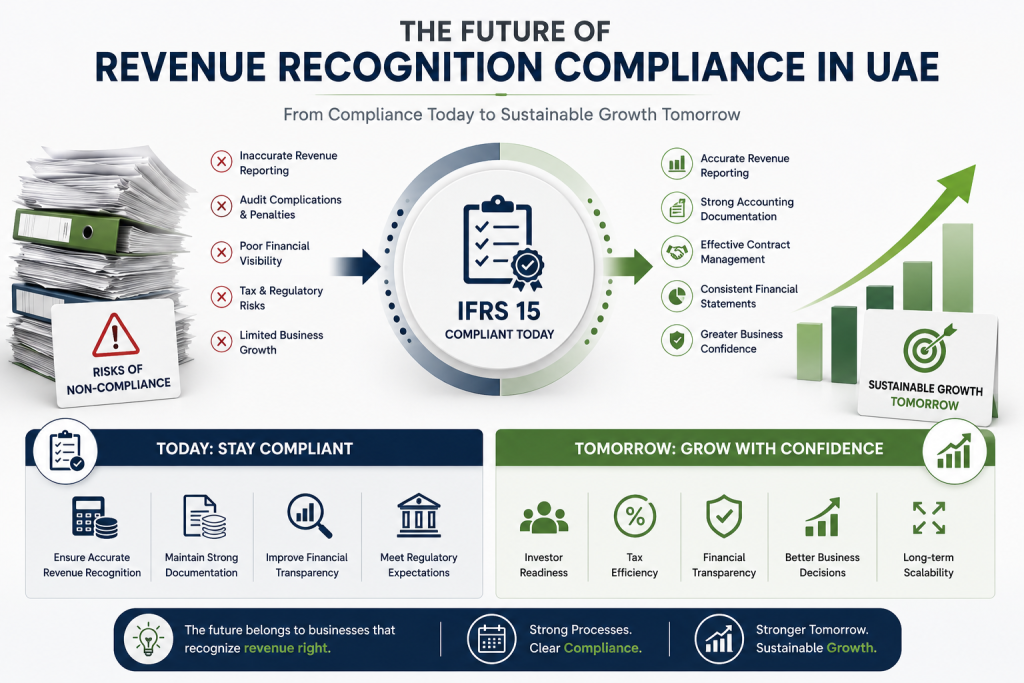
As the UAE continues strengthening its tax and financial reporting ecosystem, businesses can expect increased scrutiny around:
- Revenue reporting accuracy
- Accounting documentation
- Contract management
- Financial statement consistency
SMEs that continue relying on informal bookkeeping methods may face increasing operational and regulatory challenges.
Businesses that proactively implement IFRS 15-compliant accounting practices will be better positioned for:
- Sustainable growth
- Investor readiness
- Tax efficiency
- Financial transparency
- Long-term scalability
Final Thoughts
IFRS 15 has become one of the most important accounting standards impacting SMEs in the UAE.
From Corporate Tax compliance and audits to financial reporting accuracy and business credibility, proper revenue recognition now plays a critical role in overall business stability.
In 2026, UAE SMEs must move beyond basic bookkeeping and adopt structured, IFRS-compliant accounting systems that accurately reflect revenue and financial performance.
Businesses that invest in proper accounting practices today will reduce compliance risks, improve decision-making, and build stronger foundations for future growth.
For expert assistance with IFRS-compliant accounting, bookkeeping, VAT, and Corporate Tax support in the UAE, visit: Digits – Accounting & Bookkeeping Services
Follow us on:
FAQ
IFRS 15 is the international accounting standard that governs how businesses recognize revenue from customer contracts.
IFRS 15 helps businesses maintain accurate financial reporting, Corporate Tax compliance, and audit readiness.
Yes. SMEs operating in the UAE are expected to maintain proper accounting records aligned with recognized accounting standards, including IFRS 15 where applicable.
Businesses can improve compliance through accurate bookkeeping, proper contract management, modern accounting systems, and professional accounting support.
Performance obligations are distinct products or services promised to customers within a contract.