
The UAE Corporate Tax framework has now moved firmly into its enforcement phase. As businesses enter 2026, corporate tax compliance is no longer a preparatory exercise it is a statutory requirement with defined timelines, documentation standards, and financial consequences for non-compliance.
This guide provides a clear and practical overview of corporate tax compliance requirements in the UAE for 2026, including who must comply, what actions are mandatory, and the penalties businesses should be aware of. It also includes a structured checklist to help organisations remain compliant and audit ready.
Who Governs Corporate Tax in the UAE (and Why It Matters)
Corporate Tax in the UAE is regulated and enforced by the Federal Tax Authority (FTA). In recent years, the FTA has significantly enhanced its enforcement capabilities through:
Important clarification:
Even entities that are subject to 0% Corporate Tax are still required to register, maintain records, and file returns within prescribed timelines.
Mandatory Corporate Tax Compliance Checklist for 2026
The table below provides a high-level overview of mandatory Corporate Tax compliance actions for UAE businesses in 2026.
| Compliance Area | Mandatory Action | Key Deadline / Requirement |
| Registration | Register on FTA Corporate Tax portal | As per trade licence timeline |
| Record Keeping | Maintain accounting records | Minimum 7 years |
| Tax Computation | Adjust accounting profit to taxable income | Annually |
| Free Zone Review | Confirm Qualifying Free Zone Person status | Annually |
| Transfer Pricing | Apply arm’s length principle & documentation | Ongoing (if Applicable) |
| Return Filing | File Corporate Tax return | Within 9 months of FY end |
| Tax Payment | Pay Corporate Tax liability | By filing deadline |
1. Getting Started: Corporate Tax Registration
Taxable persons who are required to register for corporate tax as listed by the FTA must:
1) Register for corporate tax via the emaratax portal
2) File for corporate tax annually via the Emaratax portal. Failure to register within the assigned time-frame results in automatic penalties.
2. Setting the Clock Right: Deadline for Corporate Tax Filing
Corporate Tax returns must be filed within nine months from the end of the financial year.
Example:
Financial year ending 31 December 2025 → Filing deadline: 30 September 2026
3. Documentation Discipline: Maintaining Accounting Records
The FTA requires businesses to maintain accurate accounting records for at least seven years, including:
- Profit and loss statements
- Balance sheets
- Sales invoices and expense vouchers
- Bank statements
- Contracts and commercial agreements
- Corporate Tax and VAT returns.
Inadequate or inconsistent records significantly increase audit exposure.
4. Beyond Book Profits: Computing Taxable Income Correctly
Taxable income under UAE Corporate Tax is not the same as accounting profit. Businesses must apply specific tax adjustments, including:
- Disallowance of non-deductible expenses
- Treatment of exempt income
- Related-party and connected-person adjustments
- Carry-forward and utilisation of tax losses
Errors at this stage can result in underpayment, overpayment, or reassessment during audits.
5. Free Zone Reality Check: Reviewing Corporate Tax Eligibility
Free Zone entities must evaluate whether they qualify as a Qualifying Free Zone Person, based on:
- Nature of income (qualifying vs non-qualifying)
- Compliance with Economic Substance Regulations
- Maintenance of adequate operational substance
An incorrect assumption regarding Free Zone eligibility may lead to a 9% Corporate Tax exposure instead of a 0% rate.
6. Group Transactions Under the Lens: Transfer Pricing Compliance
Transfer Pricing rules apply where businesses:
- Operate within a group structure
- Share common ownership or management
- Engage in related-party or cross-border transactions
Affected entities must apply the arm’s length principle and maintain appropriate documentation to support pricing policies.
7. The Filing Obligation: Submitting Corporate Tax Returns
- Corporate Tax return filing is mandatory, even for companies who have recorded zero revenue during the corporate tax period. No matter the revenue recorded the filing should be done within the given deadline.
8. Closing the Loop: Paying Corporate Tax on Time
- Corporate Tax must be paid before the return filing deadline
- Late payments attract interest penalties calculated on a monthly basis
9. The Final Safeguard: Annual Compliance & Risk Review
Before submission, businesses should conduct a review covering:
- Reconciliation of VAT turnover with Corporate Tax revenue
- Review of expense deductibility
- Validation of Free Zone treatment (if applicable)
This step significantly reduces audit risk and post-filing corrections.
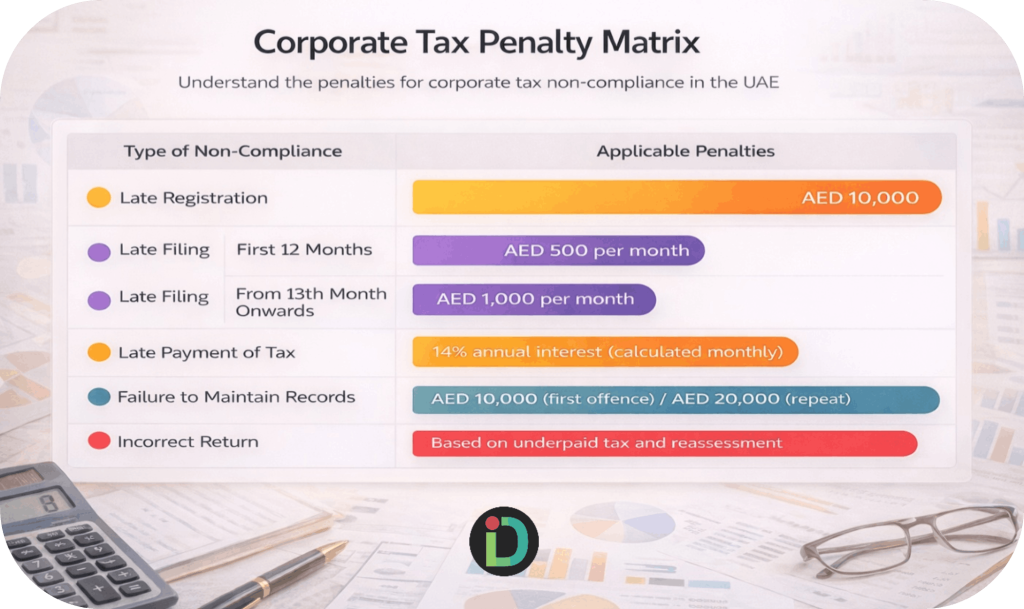
The Cost of Non-Compliance: Corporate Tax Penalties in 2026
The UAE Corporate Tax penalty framework is structured and progressive, as outlined under Cabinet Decision No. 75 of 2023.
Choosing the Right Support: Engaging Corporate Tax Advisory Services
As Corporate Tax compliance in the UAE becomes more structured and enforcement-driven, many businesses are opting to work with professional Corporate Tax advisors to reduce risk and ensure accuracy.
When evaluating Corporate Tax advisory services, businesses should consider the following:
- Regulatory expertise: Advisors should demonstrate a clear understanding of UAE Corporate Tax law, FTA guidelines, and Cabinet Decisions.
- End-to-end support: Effective advisory goes beyond return filing and includes registration, tax computation, Free Zone eligibility assessment, transfer pricing, and ongoing compliance monitoring.
- Industry exposure: Advisors with experience across SMEs, Free Zone entities, and multi-entity groups are better positioned to identify risk areas early. Different types of business industries have different corporate tax treatment, make sure the entity is following the correct treatment.
- Audit readiness: Advisory support should focus on documentation strength, reconciliations, and alignment across VAT and corporate tax filings.
- Practical implementation: Beyond interpretation of law, advisors should assist with system configuration, accounting clean-ups, and internal process alignment.
Engaging the right Corporate Tax advisory partner helps businesses manage compliance proactively rather than reactively reducing penalties, audit exposure, and operational disruption. For businesses seeking structured and practical Corporate Tax support in the UAE, digits offers Corporate Tax advisory services covering registration, return filing, Free Zone assessments, transfer pricing support, and ongoing compliance advisory.
Final Takeaway: Staying Compliant, Staying Ahead
Corporate Tax compliance in the UAE is now a core governance requirement, not a one-time filing exercise. Early preparation, accurate classification, and consistent record-keeping remain the most effective ways to manage risk and avoid penalties.
For 2026, proactive compliance is no longer optional it is essential.