

Businesses frequently transact with companies or individuals they share a close relationship with. These dealings, known as Related Party Transactions (RPTs), are common among corporate groups, family-owned businesses, subsidiaries, and companies with common ownership. While such transactions are perfectly legitimate, they require careful documentation and transparency to ensure they are conducted fairly.
With the introduction of UAE Corporate Tax and increasing emphasis on financial transparency, understanding related party transactions has become more important than ever. Whether you’re a startup, SME, or multinational business, knowing how these transactions are assessed can help you avoid compliance issues and strengthen corporate governance.
In this guide, we’ll explain what related party transactions are, why they matter, the risks involved, and the best practices businesses should follow.
What Are Related Party Transactions?
A related party transaction is any transfer of goods, services, assets, obligations, or funds between a business and another party with whom it has a special relationship. This relationship may exist through ownership, management, family connections, or significant influence over business decisions.
According to the International Accounting Standards Board’s IAS 24 – Related Party Disclosures, a related party transaction includes any transfer of resources, services, or obligations between related parties, regardless of whether a price is charged.
Examples of related parties include:
- A Dubai-based holding company and its wholly owned trading subsidiary in a UAE free zone
- Two sister companies, such as a trading firm and a logistics company, both 60% owned by the same individual shareholder
- A company’s Managing Director who also personally owns the supplier from which the company sources its raw materials
- A shareholder holding a 25% stake in a company who also leases warehouse space to that same company
- The spouse of a company’s owner, where that spouse independently runs a marketing agency retained by the company
- A 50:50 joint venture set up by two UAE SMEs, along with each partner’s individual dealings with that joint venture entity
Simply entering into a related party transaction isn’t an issue. The key concern is whether the transaction reflects fair market terms and is appropriately disclosed.
Common Examples of Related Party Transactions
Many businesses engage in related party transactions as part of their normal operations. Common examples include:
- Selling goods between a parent company and its subsidiary
- Providing management or administrative services to another group entity
- Leasing office space to a company owned by the same shareholders
- Intercompany loans and financing arrangements
- Asset transfers within a corporate group
- Shared IT, HR, or accounting services
These transactions often improve operational efficiency, but they must be properly recorded and supported with adequate documentation.
Why Related Party Transactions Matter
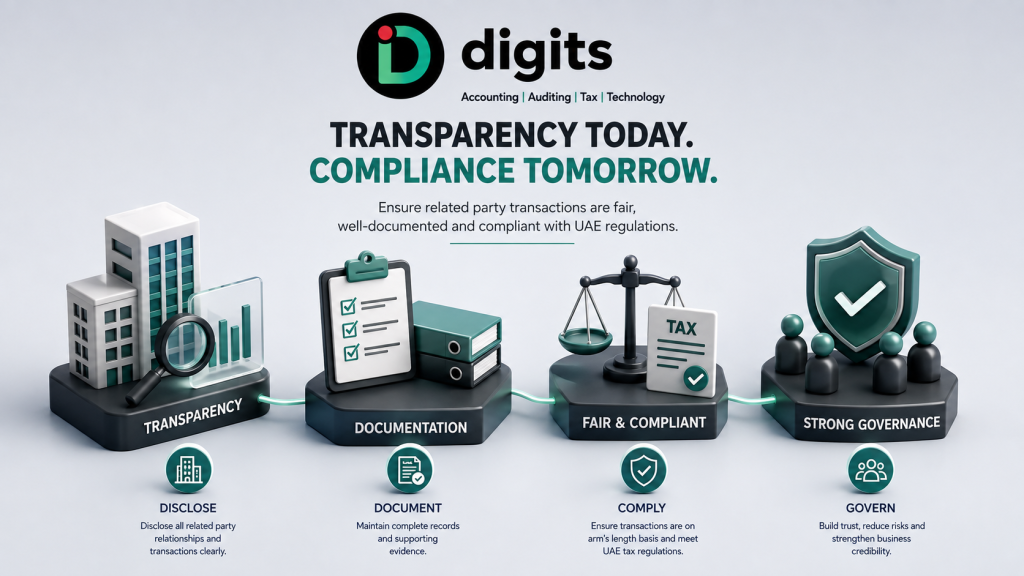
Because related parties may influence each other’s decisions, regulators and auditors pay closer attention to these transactions than those conducted with independent third parties.
The primary objective is to ensure that transactions are carried out on an arm’s length basis, meaning the pricing and terms should be comparable to what unrelated businesses would agree under similar circumstances. International guidance from the OECD reinforces the importance of this principle in promoting fair taxation and corporate governance. For businesses operating in the UAE, this has become increasingly relevant under Corporate Tax regulations. Companies should ensure their related party transactions are properly documented and supported to demonstrate compliance. Businesses seeking guidance on these requirements can benefit from Corporate Tax Services to review their tax positions and maintain regulatory compliance.
Risks Associated with Related Party Transactions
Although related party transactions are common, they can expose businesses to several risks if not managed appropriately.
Financial Reporting Risks
Incomplete or inaccurate disclosure can lead to misstated financial statements, affecting investor confidence and stakeholder trust.
Tax Compliance Risks
Transactions that are not supported by appropriate documentation or do not reflect market conditions may attract scrutiny from tax authorities.
Audit Challenges
Related party transactions are routinely reviewed during statutory audits because they may indicate conflicts of interest or increased fraud risk. Maintaining accurate financial records and supporting documentation makes the audit process significantly smoother. Businesses often strengthen their financial reporting processes through professional Audit & Assurance Services before undergoing external audits.
Governance Concerns Without proper oversight, management may unintentionally create conflicts of interest that impact business decisions or shareholder confidence.
Best Practices for Managing Related Party Transactions
Businesses can significantly reduce compliance risks by implementing strong internal controls and governance procedures.
Maintain Comprehensive Documentation
Every related party transaction should be supported by contracts, invoices, approvals, and pricing documentation. Proper record-keeping not only improves transparency but also simplifies tax assessments and audits. Reliable financial records maintained through professional Accounting & Bookkeeping Services help businesses demonstrate compliance and maintain accurate reporting.
Ensure Fair Pricing
Businesses should periodically assess whether transactions reflect market conditions and are commercially reasonable.
Review Transactions Regularly
Management should periodically review all related party transactions to identify any changes in business relationships or reporting requirements.
Strengthen Internal Controls
Clear approval processes, segregation of duties, and documented policies help minimise conflicts of interest and improve governance.
How Auditors Assess Related Party Transactions

Auditors don’t assume related party transactions are improper. Instead, they evaluate whether the transactions have been identified, accurately recorded, and appropriately disclosed.
During an audit, professionals generally assess:
- Whether all related parties have been identified
- The commercial substance of each transaction
- Supporting agreements and documentation
- Board approvals where applicable
- Compliance with applicable accounting standards
- Completeness of financial statement disclosures
The objective is to ensure users of the financial statements receive a transparent view of the company’s financial position and relationships.
RP Benchmarking from a CT Perspective
Stating that a related party transaction is priced at arm’s length is not enough for UAE Corporate Tax purposes—businesses must substantiate the claim with evidence. This is where benchmarking comes in.
A benchmarking study assesses whether the prices, margins, or fees charged in a related party transaction align with what independent businesses would have agreed under comparable conditions. It identifies comparable companies or transactions, establishes the arm’s length range (typically the interquartile range), and compares the tested party’s results against it. The Federal Tax Authority (FTA) generally considers results within the range defensible, while results outside it attract closer scrutiny.
A benchmarking study typically includes:
- A functional analysis of functions performed, assets used, and risks assumed
- A search for comparable independent companies or transactions
- Selection of the appropriate transfer pricing method
- Calculation of the arm’s length range and comparison of actual results against it
Benchmarking should be refreshed annually, with a full comparable search typically updated every three years or sooner if there are material business changes. The analysis supports the Local File and complements the Master File and Transfer Pricing Disclosure Form.
For Qualifying Free Zone Persons, arm’s length compliance is essential to retain the 0% Corporate Tax rate. If benchmarking cannot support transfer pricing and the FTA adjusts profits, preferential tax treatment may be at risk. Making benchmarking part of the annual Corporate Tax compliance process is the best way to stay audit-ready.
Final Thoughts
Related party transactions are a normal part of business operations, particularly for companies operating within corporate groups or family-owned structures. However, they also carry additional reporting and compliance responsibilities.
By maintaining accurate records, ensuring transactions are conducted on fair commercial terms, and following recognised accounting standards, businesses can reduce regulatory risks while improving transparency and governance.
As the UAE’s regulatory landscape continues to evolve, taking a proactive approach to related party transactions is essential for long-term compliance and sustainable business growth. If your organisation needs assistance with financial reporting, tax compliance, or audit readiness, seeking professional advice early can help avoid costly issues later.
Need a Transfer Pricing Benchmarking Study?
Follow Us On: