
A VAT return should be the final checkpoint, not the moment your finance team begins searching for invoices, correcting sales figures, or guessing which expenses qualify for input VAT recovery.
Yet for many UAE SMEs, VAT reconciliation becomes a last-minute scramble. The VAT return may be submitted on time, but if the figures do not properly agree with the books, bank records, sales invoices, purchase invoices, and supporting documents, the business can face avoidable errors, weak audit trails, and potential penalty exposure.
The good news? A reliable VAT reconciliation process is not complicated when bookkeeping is current, structured, and reviewed regularly.
What does VAT reconciliation mean?
VAT reconciliation is the process of matching the VAT declared in your VAT return against the underlying accounting records and documents for the same tax period. If discrepancies are identified, resolving them before filing can help avoid costly penalties and compliance issues. Businesses seeking expert support can benefit from Digits’ VAT compliance and reconciliation services to ensure accurate and timely VAT submissions.
In simple terms, you should be able to explain every number in your VAT return:
- Output VAT should agree with taxable sales and tax invoices issued.
- Input VAT should agree with eligible business purchases and supporting tax invoices.
- Zero-rated, exempt, and out-of-scope transactions should be correctly identified.
- VAT payable or refundable should reconcile to the VAT control account in your general ledger.
When these records tell the same story, filing becomes faster, more confident, and far easier to defend if questions arise later.
Where most SMEs go wrong with VAT reconciliation
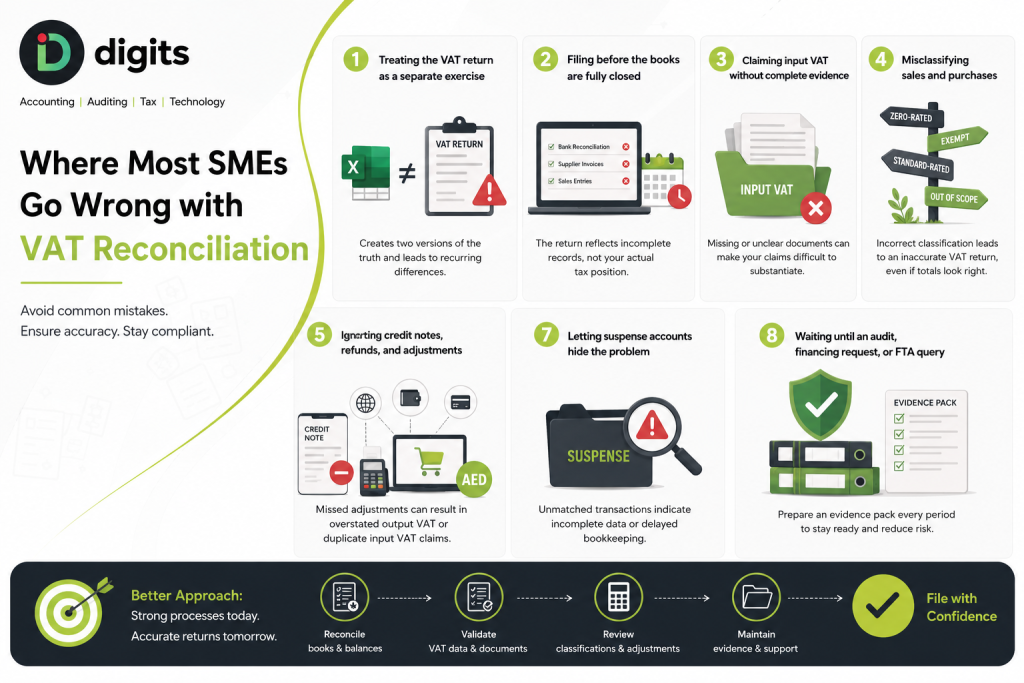
1. Treating the VAT return as a separate exercise
One of the most common mistakes is preparing the VAT return from spreadsheets or invoice folders instead of the accounting system.
This creates two versions of the truth: one in the books and another in the VAT return. Even a small difference can grow into a recurring issue over several filing periods.
Better approach: Make the VAT return a direct result of reconciled bookkeeping. Businesses using professional Accounting & Bookkeeping support can maintain reconciled sales, purchases, bank records, and VAT workings throughout the period, not only at filing time.
2. Filing before the books are fully closed
An SME may submit a VAT return while bank transactions are still unreconciled, supplier invoices are missing, or sales entries are awaiting review. The return then reflects incomplete records rather than the actual tax position.
Better approach: Establish a fixed monthly close process. Reconcile bank accounts, payment gateways, supplier balances, customer balances, and key ledger accounts before preparing VAT workings.
3. Claiming input VAT without complete evidence
Input VAT recovery is valuable, but it must be supported. Missing tax invoices, unclear supplier details, personal expenses, or unsupported payment records can make a claim difficult to substantiate.
Better approach: Maintain a clear document trail for every input VAT claim. For transaction-specific rules or changing requirements, refer to the FTA’s VAT guides and public clarifications.
4. Misclassifying sales and purchases
Not every transaction is treated the same for VAT purposes. Businesses often misclassify zero-rated, exempt, standard-rated, or out-of-scope transactions, particularly when they deal with exports, property, cross-border services, reimbursements, or mixed-use expenses.
The result is often an inaccurate VAT return, even where the total sales figure itself is correct.
Better approach: Build VAT codes into the chart of accounts and invoicing process. Review unusual or high-value transactions separately before filing.
5. Ignoring credit notes, refunds, and adjustments
Credit notes, cancelled invoices, customer refunds, supplier rebates, and prior-period corrections are frequently missed in the rush to file. This can lead to output VAT being overstated or input VAT being claimed twice.
Better approach: Keep a dedicated adjustments schedule. Every credit note and VAT correction should be traceable back to the original transaction and reflected correctly in the relevant VAT period.
6. Forgetting payment gateways, cash sales, and online channels
For trading, retail, e-commerce, hospitality, and service businesses, sales do not always flow through one bank account. Card machines, online marketplaces, delivery platforms, digital wallets, and payment gateways can each create timing differences and fee deductions.
Better approach: Reconcile gross sales, platform commissions, payment gateway settlements, and cash received separately. The amount deposited into the bank is not always the same as the taxable sale amount.
7. Letting suspense accounts hide the problem
A suspense account can be useful temporarily. When unmatched transactions accumulate in the VAT control account, they often indicate delayed bookkeeping or VAT calculations based on incomplete data.
Better approach: Investigate and clear suspense items before finalising the VAT return. Investigate every unexplained transaction instead of carrying it forward without resolution.
8. Waiting until an audit, financing request, or FTA query
A VAT return without supporting reconciliations is a risk that stays hidden until someone asks for evidence. By then, staff may have changed, documents may be difficult to locate, and correcting historic periods becomes more expensive.
Better approach: Prepare an evidence pack for every VAT period, including VAT workings, ledger reports, reconciliations, tax invoices, adjustment schedules, and management sign-off.
A practical VAT reconciliation checklist for SMEs
Before submitting your VAT return, ask:
- Reconcile total sales in the VAT return with the sales ledger.
- Reconcile all bank accounts, payment gateways, and cash collections.
- Match output VAT with sales invoices and credit notes.
- Match input VAT with eligible purchase invoices and expense records.
- Review all zero-rated, exempt, and out-of-scope transactions.
- Reconcile supplier and customer balances.
- Verify and explain VAT control account balances.
- Document all corrections, refunds, and adjustments. Maintain an evidence pack to support every box in the VAT return.
If the answer to any of these is “not yet,” the return may need further review before submission.
How Digits helps SMEs turn VAT reconciliation into a controlled process
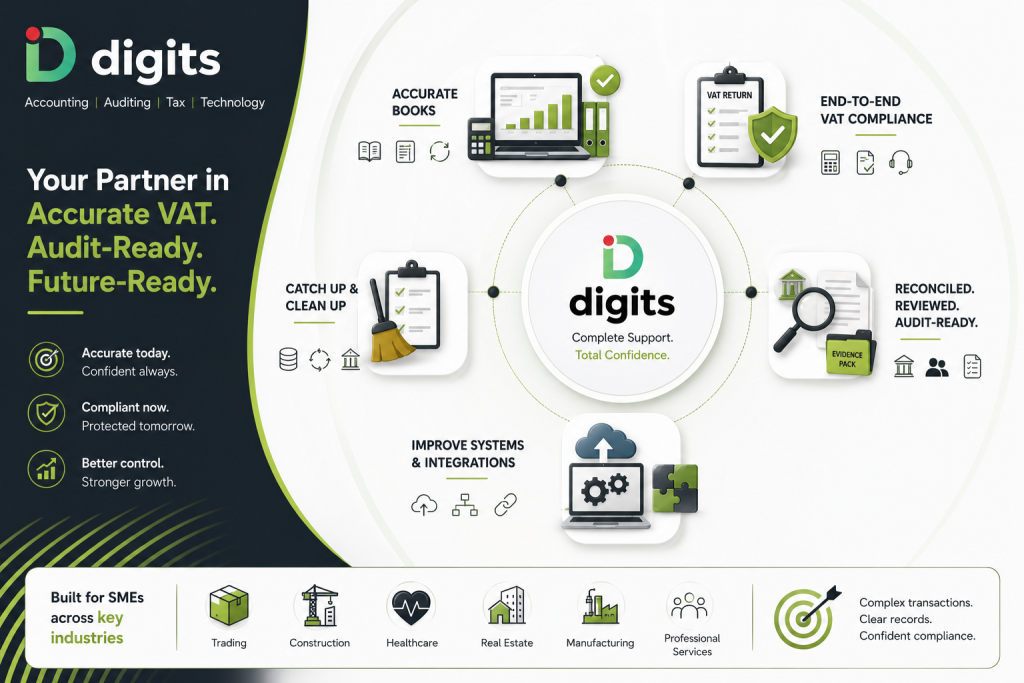
At Digits, we help SMEs move away from reactive VAT filing and towards accurate, audit-ready financial control. Our Accounting & Bookkeeping services keep financial records current through routine bookkeeping, journal entries, and reconciliations. For end-to-end compliance support, including VAT computations, return filing, health checks, and audit support – explore our UAE VAT Services.
Digits supports monthly or quarterly bookkeeping and reconciliations across bank accounts, cards, wallets, payment gateways, suppliers, customers, and intercompany balances. The team also prepares VAT-compliant reporting with box-wise workings, exception checks, and evidence packs to support VAT filings.
For businesses that need to catch up, Digits can support backlog clean-up, ledger rebuilds, reclassifications, bank and gateway reconciliations, and VAT corrections. For businesses ready to improve their systems, the team can assist with cloud setup and migration, chart-of-accounts design, and integrations with platforms such as Zoho Books, QuickBooks, and Tally.
This is especially valuable for SMEs in trading, construction, healthcare, real estate, manufacturing, and professional services, where transaction volumes, project costs, inventory, payment channels, or industry-specific reporting can make VAT reconciliation more complex.
The Bottom line
Your VAT return should not be a surprise. It should be the natural outcome of well-maintained books, reconciled accounts, and documented decisions.
For UAE SMEs, getting this right protects cash flow, reduces compliance risk, and gives management a clearer view of the business. With the right bookkeeping discipline, and the right accounting partner, VAT reconciliation becomes less of a deadline-driven headache and more of a reliable financial routine.
Ready to make your VAT reporting clearer and more controlled?
Follow Us On: