
Introduction
The UAE’s e-invoicing mandate is rapidly approaching, and businesses across the country are beginning to assess whether their financial systems can meet the upcoming compliance requirements.
While many organizations use popular accounting platforms, a significant number of businesses rely on custom-built ERP systems, proprietary accounting software, or industry-specific invoicing solutions developed to match their operational needs. These systems may work perfectly today, but the introduction of UAE e-invoicing raises an important question:
Is your custom accounting software actually ready for compliance?
Many business owners assume that if their software can generate invoices, it will automatically meet e-invoicing requirements. Unfortunately, that isn’t always the case. The UAE’s upcoming framework will require businesses to exchange structured invoice data through approved channels, maintain digital audit trails, and adhere to technical standards that many legacy systems were never designed to support.
Businesses that evaluate their systems today will be better positioned to avoid costly upgrades, compliance risks, and operational disruptions tomorrow.
Is Your Software Ready for UAE E-Invoicing? Essential Compliance Requirements
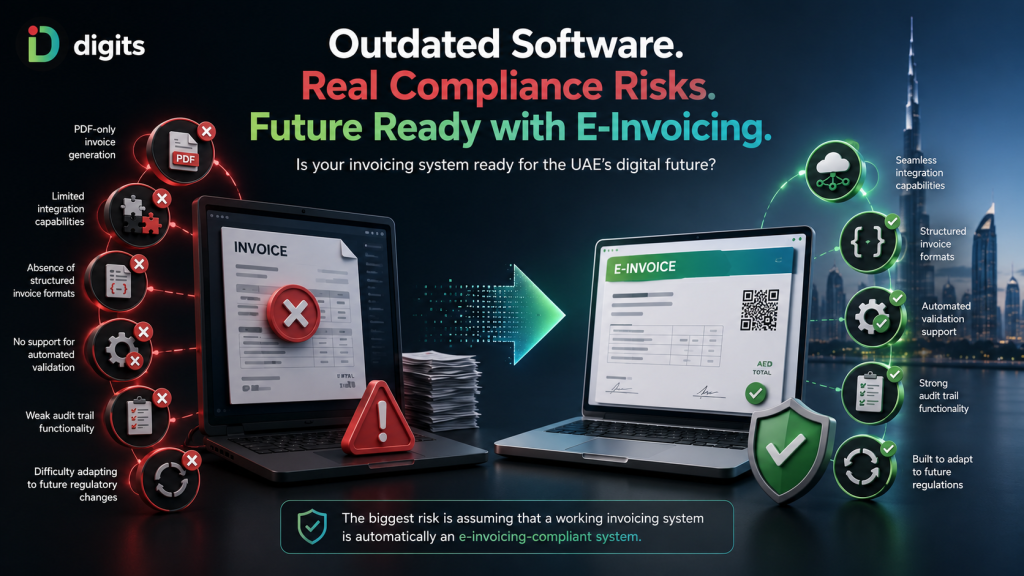
Custom software offers flexibility and control, but it can also create compliance challenges when regulations evolve.
Many bespoke accounting systems were built years before e-invoicing became a regulatory requirement. As a result, they may lack the capabilities needed to support the UAE’s digital invoicing framework.
Common limitations include:
- PDF-only invoice generation
- Limited integration capabilities
- Absence of structured invoice formats
- No support for automated validation
- Weak audit trail functionality
- Difficulty adapting to future regulatory changes
The biggest risk is assuming that a working invoicing system is automatically an e-invoicing-compliant system.
As the UAE moves toward a more connected and standardized invoicing environment, businesses will need software capable of supporting evolving technical requirements and seamless data exchange. To better understand the upcoming requirements, businesses can refer to the official UAE Ministry of Finance E-Invoicing Initiative.
7 Questions Every Business Should Ask Their Software Vendor
Before the UAE e-invoicing mandate becomes mandatory for your organization, it’s important to have a direct conversation with your software provider.
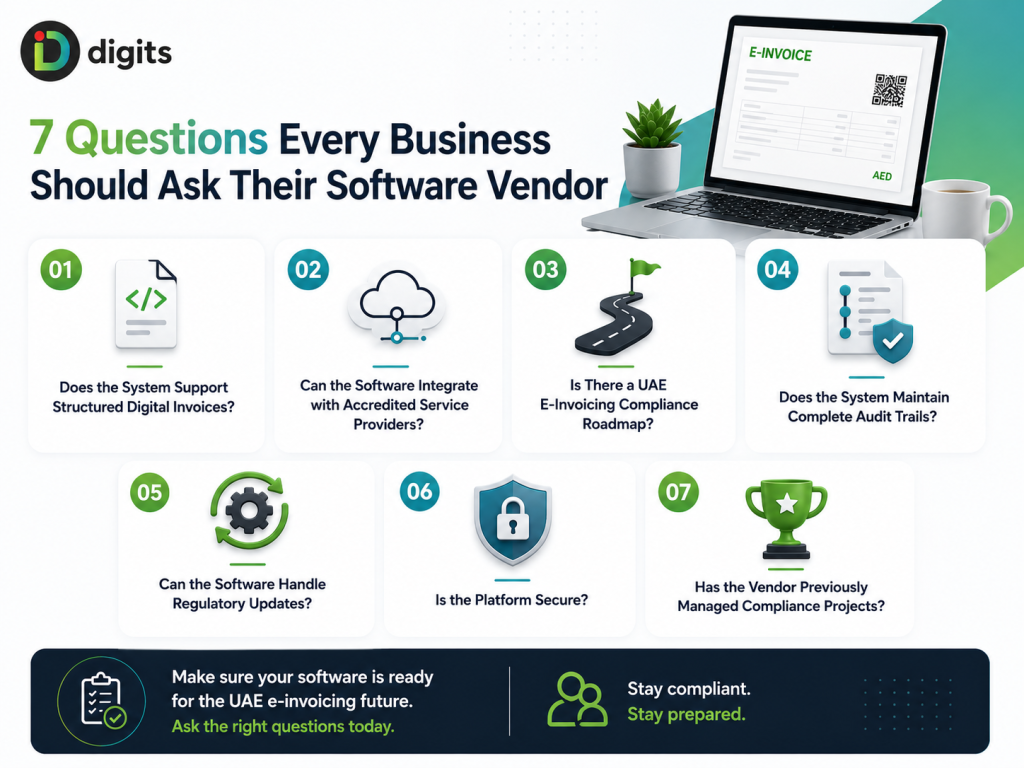
1. Does the System Support Structured Digital Invoices?
Traditional PDF invoices may not satisfy future compliance requirements. Your software should be capable of generating invoice data in structured formats that can be processed electronically.
2. Can the Software Integrate with Accredited Service Providers?
The UAE’s framework relies on accredited service providers to facilitate invoice exchange. If your software cannot integrate with these platforms, additional development may be required.
3. Is There a UAE E-Invoicing Compliance Roadmap?
A reliable software vendor should already have a documented strategy for supporting UAE e-invoicing requirements.
If your provider cannot clearly explain their roadmap, that should raise concerns.
4. Does the System Maintain Complete Audit Trails?
Every invoice action should be traceable, including creation, edits, approvals, cancellations, and transmissions.
Strong audit trails are essential for compliance and future audits.
5. Can the Software Handle Regulatory Updates?
Regulations evolve. Your software should be capable of adapting without requiring major redevelopment every time a new requirement is introduced.
6. Is the Platform Secure?
Financial data security is becoming increasingly important. Ask about encryption, user permissions, access controls, backup procedures, and compliance certifications.
7. Has the Vendor Previously Managed Compliance Projects?
Experience matters. Vendors with a track record of adapting to tax and compliance regulations are generally better equipped to support future changes.
Factors to Consider When Evaluating an E-Invoicing Provider
As demand for e-invoicing solutions grows, many software providers are marketing themselves as “e-invoicing ready.”
However, not all solutions offer the same level of compliance support.
Before making any investment, businesses should conduct proper due diligence.
Verify Ministry of Finance Recognition
One of the first steps is reviewing the UAE Ministry of Finance’s list of Pre-Approved E-Invoicing Service Providers. This helps businesses determine whether a provider is aligned with the government’s framework and evolving requirements.
Check PEPPOL Compatibility
The UAE’s e-invoicing model is based on PEPPOL standards.
A legitimate provider should be able to explain:
- Their PEPPOL capabilities
- Integration approach
- Data exchange processes
- Future compliance strategy
Businesses can also review the official OpenPeppol website to better understand how the framework supports secure and standardized invoice exchange.
Request Documentation
A reputable provider should be able to demonstrate:
- Security standards
- Technical specifications
- Integration capabilities
- Compliance readiness plans
- Customer success stories
If a vendor is unable to provide this information, businesses should proceed with caution.
Red Flags That Your Current System May Not Be Compliant
Many organizations discover compliance issues only when implementation deadlines approach.
Watch for these warning signs:
- Your invoices are generated only as PDFs.
- Most invoice data is entered manually.
- Your system lacks API capabilities.
- The vendor has not communicated any e-invoicing updates.
- There is limited audit trail functionality.
- Software updates are infrequent.
- The system relies heavily on spreadsheets and manual processes.
If any of these issues exist, a readiness assessment should be prioritized.
For businesses evaluating their accounting infrastructure, understanding the latest compliance requirements is essential. You can also explore our UAE E-Invoicing Compliance Checklist for Businesses to identify potential gaps before the mandate takes effect.
Why Many Businesses Are Moving to Supported Accounting Platforms
As compliance requirements become more complex, businesses are increasingly shifting away from unsupported or heavily customized systems.
Modern accounting platforms offer several advantages:
- Regular compliance updates
- Improved security
- Better reporting capabilities
- Easier integrations
- Reduced maintenance costs
- Scalability for future growth
Rather than continuously modifying legacy systems, many organizations find it more cost-effective to adopt actively supported accounting solutions.
Why Choose Digits for UAE E-Invoicing Readiness?
Successfully preparing for UAE e-invoicing requires the right combination of technology and expertise. At Digits, our certified accounting and ERP specialists help businesses assess their current systems, identify compliance gaps, and implement solutions that support evolving regulatory requirements.
What Sets Digits Apart?
- Certified accounting and ERP professionals
- Expertise in Tally implementation and support
- Compliance-focused system assessments
- End-to-end implementation and training assistance
- Scalable solutions designed for future regulatory changes
Whether you’re using a custom ERP, legacy accounting software, or manual invoicing processes, Digits can help you build a practical roadmap toward UAE e-invoicing compliance while improving operational efficiency.
To learn more about our accounting and ERP solutions, visit our Tally Partner UAE Services page.
How Tally Helps Businesses Prepare for UAE E-Invoicing
Preparing for e-invoicing isn’t just about meeting a regulatory requirement, it’s about building a financial system that can support future business growth.
As an authorized Tally partner, Digits helps businesses:
- Assess current accounting systems
- Identify compliance gaps
- Streamline financial processes
- Improve reporting accuracy
- Implement scalable accounting solutions
- Prepare for future regulatory requirements
Whether you’re currently using spreadsheets, legacy accounting software, or a custom-built ERP, an expert assessment can help determine the most practical path toward compliance.
Learn more about our Tally Partner Services here:
https://www.digits-me.com/tally-partner.html
Conclusion
The UAE’s e-invoicing initiative represents more than a compliance requirement, it marks a significant shift toward a fully digital financial ecosystem.
For businesses using custom accounting software, the greatest risk is not the software itself. The real risk is assuming that the software is compliant without verifying it.
By evaluating your systems early, asking the right questions, and working with experienced implementation partners, your business can avoid unnecessary disruption and transition smoothly into the next phase of digital compliance.
The best time to assess your accounting system is now! before compliance deadlines begin to impact your operations.
If you’re unsure whether your current system is ready, speaking with experienced professionals at Digits Consulting can help you identify compliance gaps and build a clear roadmap toward implementation.
Follow Us for More Updates: