
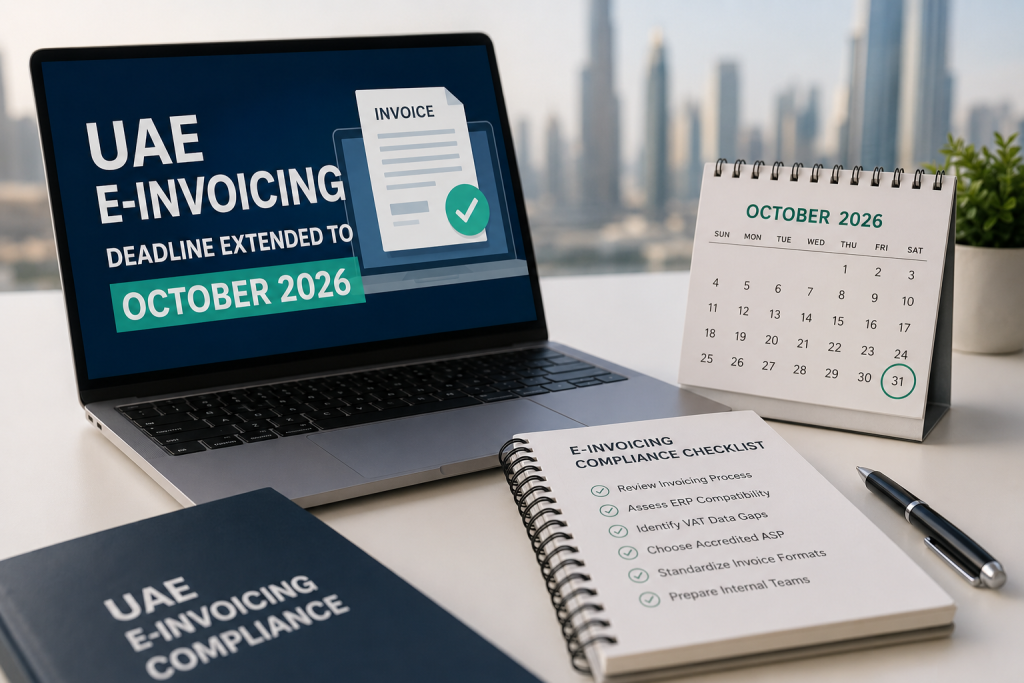
The extension of the UAE e-invoicing ASP selection deadline to October 2026 is not a postponement of compliance obligations. It is a final opportunity for businesses to correct delays, strengthen systems, and prepare for seamless implementation before regulatory enforcement intensifies.
For businesses with turnovers exceeding AED 50 million, this additional time should not be viewed as extra breathing space. Instead, it should be treated as a strategic preparation window to ensure systems, processes, and compliance structures are fully aligned with the UAE’s evolving digital tax ecosystem.
Many organizations have delayed preparation, assuming implementation timelines would continue shifting. However, businesses that act early will be significantly better positioned to avoid operational disruption, compliance risks, and costly last-minute transitions.
This checklist outlines the critical areas UAE businesses should prioritize before October 2026.
Why the E-Invoicing Deadline Extension Matters
The UAE’s move toward mandatory e-invoicing is part of a broader digital transformation initiative designed to improve transparency, streamline tax reporting, and strengthen compliance monitoring, as outlined by the UAE Ministry of Finance’s e-invoicing framework
The extension for selecting an Accredited Service Provider (ASP) gives businesses more time to:
- Evaluate technology readiness
- Upgrade invoicing systems
- Improve VAT data accuracy
- Train internal teams
- Ensure ERP compatibility
- Build compliant invoice workflows
However, businesses that wait until the final months may face:
- Limited implementation support availability
- Rushed ERP integrations
- Data inconsistencies
- Compliance gaps
- Operational disruptions during migration
The smartest organizations will use this extension period proactively.
UAE E-Invoicing Compliance Checklist for Businesses
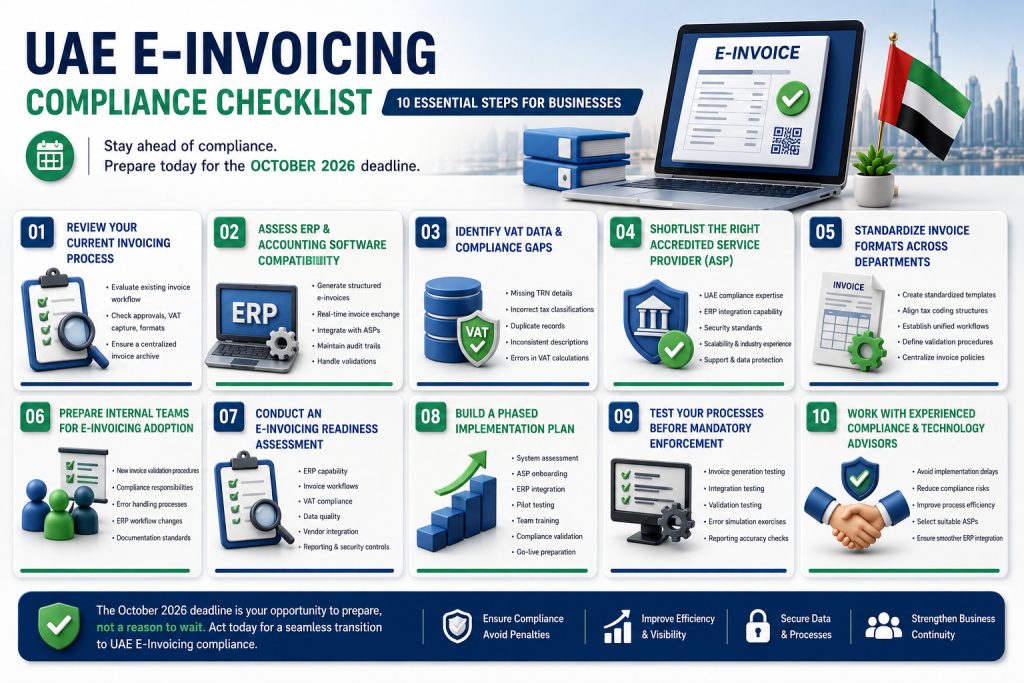
1. Review Your Current Invoicing Process
Start by understanding how invoices currently move through your organization.
Key questions to evaluate:
- Are invoices generated manually or through an ERP?
- Is invoice approval standardized?
- Are VAT details consistently captured?
- Are invoice formats uniform across departments?
- Is there a centralized invoice archive?
Many businesses discover hidden inefficiencies only during compliance preparation.
A process review now can prevent major complications later.
2. Assess ERP & Accounting Software Compatibility
One of the biggest misconceptions is assuming existing accounting software will automatically support UAE e-invoicing requirements.
Businesses should immediately evaluate whether their systems can:
- Generate structured electronic invoices
- Support real-time invoice exchange
- Integrate with approved ASPs
- Maintain secure audit trails
- Handle automated validation requirements
If your ERP requires customization or upgrades, implementation timelines could be longer than expected.
This is especially critical for businesses using legacy accounting systems.
Businesses already using modern ERP platforms such as TallyPrime should begin evaluating how their existing setup aligns with upcoming UAE e-invoicing requirements.
As an authorized Tally partner in the UAE, Digits Consulting helps businesses streamline ERP implementation, compliance alignment, invoicing workflows, and accounting automation through tailored Tally solutions.
TallyPrime offers businesses several operational advantages, including:
- Simplified accounting and invoicing workflows
- Better inventory and financial management
- Improved reporting visibility
- Scalability for growing businesses
- Easier compliance tracking and audit readiness
However, even with advanced ERP systems, businesses still require proper configuration, workflow optimization, and compliance guidance to ensure readiness for UAE e-invoicing regulations.
Learn more about our Tally ERP and compliance support services here: Digits – Authorized Tally Partner
3. Identify VAT Data & Compliance Gaps
E-invoicing depends heavily on clean, standardized tax data.
Businesses should conduct a thorough VAT data review to identify:
- Missing TRN details
- Incorrect tax classifications
- Duplicate vendor/customer records
- Inconsistent invoice descriptions
- Errors in VAT calculations
Poor data quality can create serious compliance risks once automated validations become mandatory.
This is the ideal time to improve data governance practices.
4. Shortlist the Right Accredited Service Provider (ASP)
Choosing the right ASP is not simply a technical decision. It directly impacts compliance efficiency, scalability, and operational continuity.
Businesses should evaluate ASPs based on:
- UAE compliance expertise
- ERP integration capability
- Security standards
- Scalability
- Industry experience
- Ongoing support structure
- Data protection measures
Rushing ASP selection later may lead to poor implementation outcomes.
The earlier businesses begin vendor evaluation, the better their transition process will be.
5. Standardize Invoice Formats Across Departments
Many large organizations operate with fragmented invoicing practices across multiple business units.
Before e-invoicing implementation, businesses should:
- Create standardized invoice templates
- Align tax coding structures
- Establish unified approval workflows
- Define invoice validation procedures
- Centralize invoice policies
Standardization improves implementation speed and reduces compliance inconsistencies.
6. Prepare Internal Teams for E-Invoicing Adoption
Technology alone will not ensure successful compliance.
Finance, operations, procurement, IT, and management teams all need awareness of how e-invoicing will impact day-to-day operations.
Training should focus on:
- New invoice validation procedures
- Compliance responsibilities
- Error handling processes
- ERP workflow changes
- Documentation standards
Businesses that ignore internal readiness often struggle during implementation phases.
7. Conduct an E-Invoicing Readiness Assessment
Before implementation begins, businesses should perform a complete readiness review covering:
- ERP capability
- Invoice workflows
- VAT compliance
- Data quality
- Vendor integration readiness
- Reporting structures
- Security controls
This assessment helps identify gaps early while there is still enough time to fix them strategically.
8. Build a Phased Implementation Plan
Large-scale compliance projects should never be executed at the last minute.
A phased implementation roadmap should include:
- System assessment
- ASP onboarding
- ERP integration
- Pilot testing
- Team training
- Compliance validation
- Go-live preparation
Businesses that implement gradually typically experience fewer disruptions.
9. Test Your Processes Before Mandatory Enforcement
Testing is one of the most overlooked stages of compliance preparation.
Businesses should conduct:
- Invoice generation testing
- Integration testing
- Validation testing
- Error simulation exercises
- Reporting accuracy checks
Waiting until enforcement deadlines to test systems can create operational bottlenecks.
10. Work With Experienced Compliance & Technology Advisors
E-invoicing implementation is not only a finance project. It involves compliance, operations, ERP systems, and digital transformation strategy.
Working with experienced advisors can help businesses:
- Avoid implementation delays
- Reduce compliance risks
- Improve process efficiency
- Select suitable ASPs
- Ensure smoother ERP integration
Professional guidance can significantly reduce costly mistakes during transition.
The Biggest Mistake Businesses Can Make Right Now
The most dangerous assumption is believing that October 2026 is still “far away.”
For large organizations, ERP modifications, vendor evaluations, compliance testing, and workflow restructuring can take months.
Businesses that delay preparation may eventually face:
- Increased implementation costs
- Limited ASP support availability
- Rushed compliance decisions
- Higher operational risk
- Potential regulatory complications
The extension should be treated as a preparation advantage — not a reason to postpone action further.
Final Thoughts
The UAE’s e-invoicing transformation is moving businesses toward a more transparent, digitally connected tax environment.
The extension of the ASP selection deadline to October 2026 provides businesses with a valuable opportunity to prepare properly, strengthen compliance systems, and avoid last-minute operational stress.
Organizations that act now will gain:
- Better implementation control
- Stronger compliance readiness
- Improved operational efficiency
- Reduced disruption risks
- Greater long-term scalability
The question is no longer whether businesses should prepare for e-invoicing.
The real question is whether they will use this additional time wisely.
Prepare Your Business for UAE E-Invoicing with Expert Guidance
At Digits Consulting, we help businesses navigate evolving UAE compliance requirements through strategic accounting, ERP, VAT, and digital transformation support.
As an authorized Tally partner in the UAE, we support businesses with:
- TallyPrime implementation and customization
- ERP optimization
- Accounting automation
- VAT and compliance alignment
- E-invoicing readiness support
- Financial workflow standardization
Whether your business is upgrading systems or preparing for UAE e-invoicing implementation, the right ERP and compliance strategy can significantly reduce operational disruption and compliance risks.
Follow us on:
Explore our services: